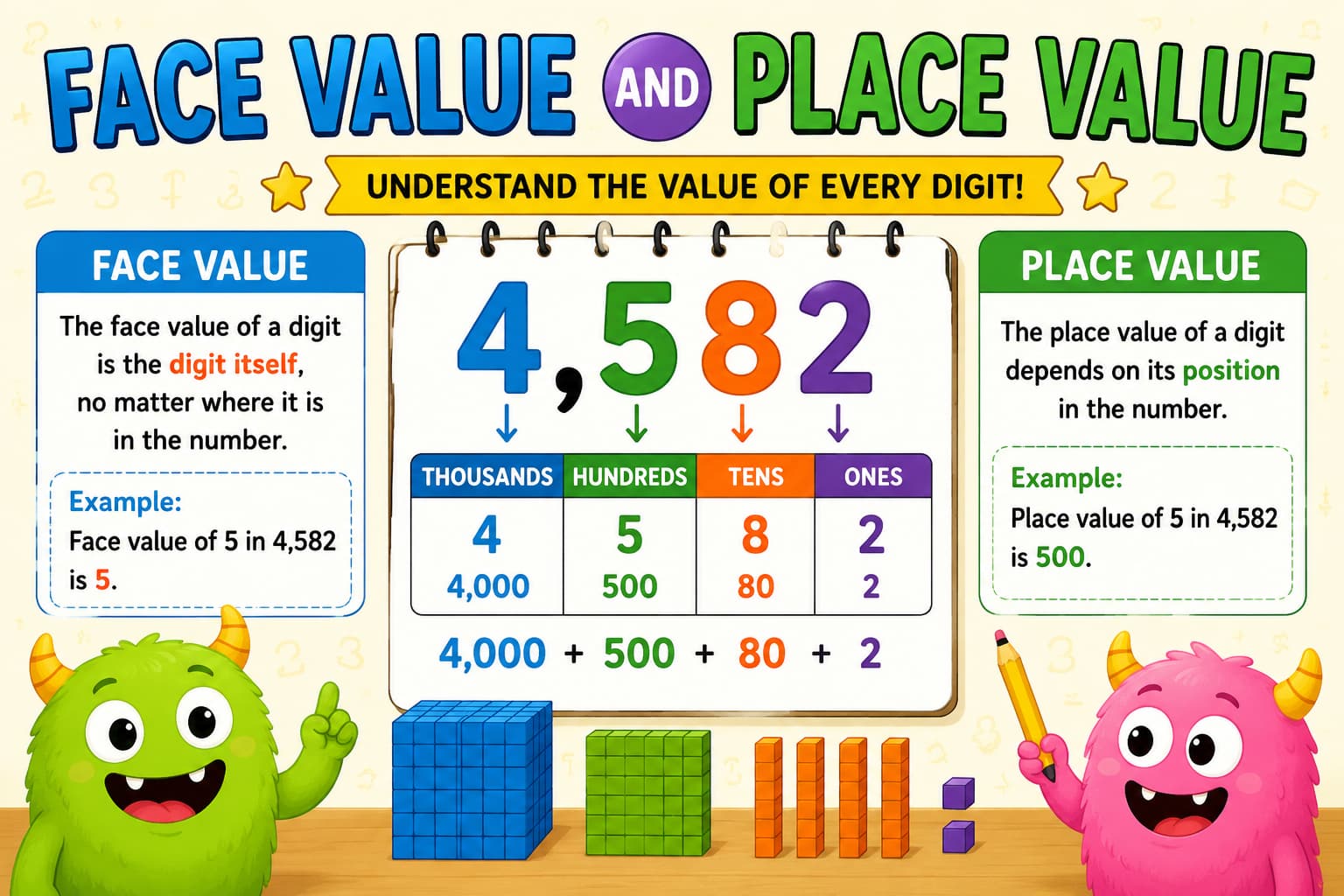
Face Value and Place Value Explained with Examples
Understanding face value and place value is one of the most important concepts in mathematics. Every digit in a number has a value based on its position. Once students understand this concept, they can easily learn expanded form, comparing numbers, and arithmetic operations.
In this lesson, let us learn the difference between face value and place value with simple examples.
What is Face Value?
The face value of a digit is the digit itself, regardless of where it is placed in a number.
Definition
Face Value = The actual value of the digit.
Examples
- Face value of 7 in 7,452 is 7.
- Face value of 3 in 5,318 is 3.
- Face value of 9 in 2,967 is 9.
The face value never changes.
What is Place Value?
The place value of a digit depends on the position it occupies in a number.
Definition
Place Value = Digit × Value of its place
The places in a number are:
| Place | Value |
|---|---|
| Ones | 1 |
| Tens | 10 |
| Hundreds | 100 |
| Thousands | 1,000 |
| Ten Thousands | 10,000 |
Place Value Example
Consider the number:
4,582
| Digit | Place | Place Value |
|---|---|---|
| 4 | Thousands | 4,000 |
| 5 | Hundreds | 500 |
| 8 | Tens | 80 |
| 2 | Ones | 2 |
Expanded Form:
4,582 = 4,000 + 500 + 80 + 2
Difference Between Face Value and Place Value
| Face Value | Place Value |
|---|---|
| The digit itself | Depends on the position of the digit |
| Never changes | Changes with position |
| Example: Face value of 5 is always 5 | Place value of 5 can be 5, 50, 500, 5,000, etc. |
