Whole Numbers and Common Mistakes Students Make
Whole numbers are one of the basic concepts in mathematics. Students learn whole numbers after natural numbers.
What Are Whole Numbers?
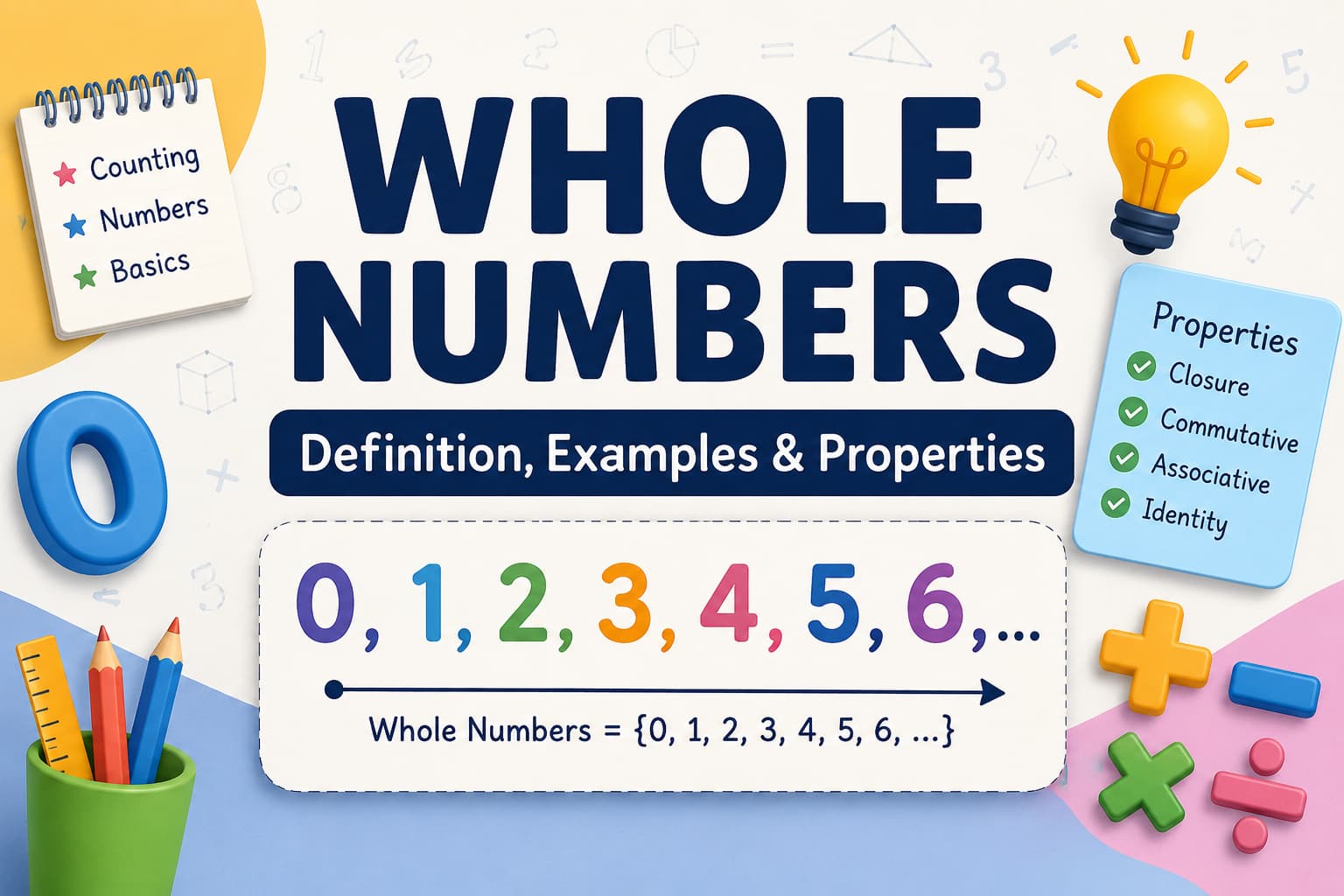
Whole numbers include all natural numbers along with zero.
The set of whole numbers is:
0, 1, 2, 3, 4, 5, 6, 7, 8, 9…
Important Points About Whole Numbers
- Whole numbers start from 0.
- They do not include negative numbers.
- They do not include fractions or decimals.
- Whole numbers continue endlessly.
Difference Between Natural Numbers and Whole Numbers
Natural numbers start from 1.
Example:
1, 2, 3, 4, 5…
Whole numbers start from 0.
Example:
0, 1, 2, 3, 4, 5…
So, zero is the main difference between natural numbers and whole numbers.
Common Mistakes Students Make
1. Forgetting Zero
Many students think whole numbers start from 1. But whole numbers always include 0.
Wrong:
1, 2, 3, 4…
Correct:
0, 1, 2, 3, 4…
2. Including Negative Numbers
Negative numbers are not whole numbers.
Wrong:
-1, 0, 1, 2
Correct:
0, 1, 2, 3…
3. Including Fractions and Decimals
Fractions and decimals are not whole numbers.
Wrong:
1.5, 2.3, 4½
Correct:
1, 2, 3, 4
4. Confusing Natural Numbers and Whole Numbers
Students often use both terms interchangeably. The only difference is that whole numbers include zero.
Uses of Whole Numbers
Whole numbers are used in:
- Counting objects
- Number patterns
- Basic arithmetic
- Daily life calculations
Conclusion
Whole numbers are simple but very important in mathematics. Understanding the difference between natural numbers and whole numbers helps students avoid common mistakes in higher mathematics.
